Thursday, 7 July 2016

Food we really like in Japan (Part 6)

Onigiri - maybe the ultimate Japanese snack food! These were available at every convenience store, staton stall and supa for around 100 yen. 

A triangle of rice, with a little flavour morsel (e.g. tuna and mayo, pickled plum, beef) hidden in the middle, wrapped in nori. 


PS Japanese rice is a special short grain variety that, when cooked correctly, is quite sticky without being gluggy - brilliant for onigiri, inarizushi, dozo..... I hope we can find this back in Australia as it is also quite tasty. 

PPS I also read, and have noticed during our travels, that gohan (rice) is an important dish in its own right in Japan; not treated as an accompaniment, as we tend to use it in Australia. It is most polite to eat every last grain from your gohan bowl, as a sign of respect for the rice growers - we did our best, with our newbie ohashi (chop stick) skills! 

Tōkyō ni modorimasu

Thursday 7 July 2016

After a bit of a restless night for the family on futons and tatami (we will all enjoy our own beds back home in Australia), Ben and I headed down to the onsen for an early morning bath, then Kerryn joined us for ocha and morning kōhī in the small lounge area at our ryokan while we waited for Joel and Em. 


We feasted again on a traditional Japanese breakfast - 11 different items (but no sake) this morning.  Again most items where new to us and, apart from a croissant, we had never had food like this for breakfast before! But it was delicious and quite filling - a noodle tomato lettuce salad and a miso ball cooked over the candle burner on the table and eaten with rice were highlights. 


Wishing we could stay a bit longer at the ryokan and Takayama, we packed our bags to head for the station. Along the way Kerryn stopped for some quick souvenir shopping while Em and I tried a local specialty - Hida Gyu-man, a soft hot bun with beef filling. Delicious! 


We were also accosted by groups of Japanese junior high school kids who seemed to be on assignment to talk in English to tourists - they asked our names, where we were from and what we like about Japan. The school girls got the giggles when they saw Ben's Pokemon backpack then when he took off his sunglasses there was more giggling as they thought he was cute and they all said Australia was great. "Nihon no subarashii kuni desu", I said, in reply!


We took the limited express through the Japan Alps to Nagoya. It was a slow but picturesque trip with the train line following the valleys, alongside a river for much of the way. In between the lush forested mountains and hillsides, we past a number of small towns and villages, consisting of groups of houses, all with productive looking vegetable plots, interspersed with green rice paddies. 


Our ekiben on this trip was a kiddies sarubobo lunch box filled with rice, beef, prawn, cheese and a range of pickled vegetables - which Kerryn and I shared.  The kids, perhaps feeling a little less adventurous after the ryokan meals,  opted for sandwiches and melon pan. 


Quick change at Nagoya and we were back on the Shinkensen for a super-express trip back to Tokyo. 


It was a bit of a shock to the system to be back in bustling Tokyo, but we braved the crowds in the massive underground shopping mall, beneath Tokyo Station 


ton find Character Street and the Pokemon Shop for Ben. A couple of wrong turns and then we were there, with Ben zeroing in like a bee to honey! A little while later, he emerged with some gifts for his friends and a special-release Tokyo Station Pikachu. Mission accomplished!


For our last night in Tokyo, we went a bit "fancy-pants" and taken hotel rooms in downtown Tokyo, a short walk from Shimbashi Station. We are staying on the 19th Floor of the Mitsui Garden Hotel Ginza, with a gorgeous panorama of Tokyo, day and night!


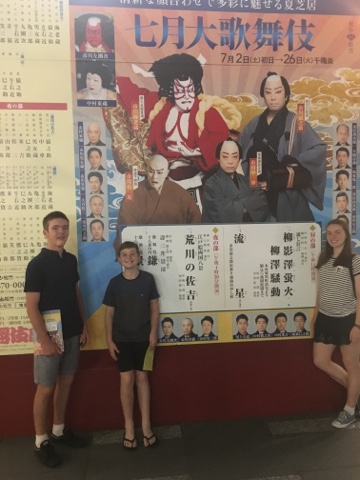
We freshened up, after a long day train travel, and frocked up before going for a quick dinner at a local Chinese/Japanese restaurant, then on to catch the last act of Kabuki at the nearby Kabukiza Theatre. 


A full show is made up of several stories, each with multiple acts and can go for around four and half hours. However, you can buy entry into single acts, in the half hour before they start, to get a taste of Kabuki. 


The Kabukiza is a beautiful old theatre in Ginza. We arrived just in time for the last act of the show - Kagekiyo from the story Kotohoide Mimasu Kagekiyo. We were only able to get standing room tickets (this was OK as the act we were watching was less than an hour) but we hired a translator so we would understand the story and follow along with the dialogue. This was loads of fun, as the costumes and make-up were spectacular, and the acting impressive - with the lines delivered in a kind of sing-sog speech but no microphones (we heard it all quite clearly from standing room up tha back.  


There were all the various elements of kabuki on display, including traditional musical instruments (played from a side-stage upper room), impressive entries through the audience and simultated flight sequences. Joel, in particular, really enjoyed the kabuki, having learnt about it in drama studies at school. 


We wandered home along the busy night-time streets of downtown Tokyo, stopping off at a convinence store for ice creams. 


Wednesday, 6 July 2016

No escaping elections

Having been on holidays in the lead up to  the Australian Federal elections, held last Saturday 2 July (we did a pre-poll postal vote before we left for our trip), we thought we had escaped much of the election campaigning! (Although we have been watching the outcome of the Australian election with interest, via social media).


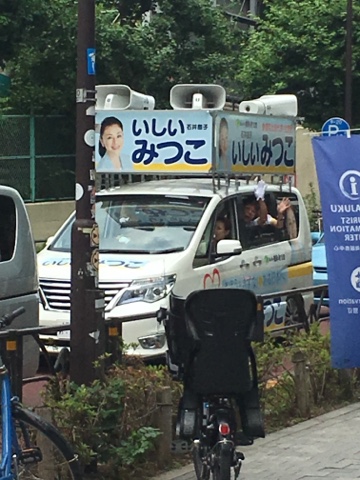
Not so! Election campaigning for the Japanese senate is in full flight here, in the lead up to the senkyo, being held this coming Sunday, 10 July. So as we have travelled around Japan we have noticed loads of billboards with pictures of very earnest looking politicians and had our ears assaulted by a steady stream of minivans driving past with loud-hailers blaring as politicians and party workers extol the virtues of their esteemed candidate. 


Ah politics - you just can't avoid it!! But probably no chance of a "democracy sausage" on Sunday, I reckon....

Tuesday, 5 July 2016

Ryokan de rirakkusu

Wednesday 6 July 2016

After pre-breakfast of yogurt, hot cakes and drip coffee, we left the older kids to have a bit of a sleep in, while we had toast and jam with barista coffee at the tiny bar of our hotel. Kerryn really enjoyed her first real latte in two weeks - saikodesu na!


We packed our bags and headed to the station to organise the train trip to Takayama. We had a bit of a wait for our train so Kerryn browsed around the gourmet foods section of the depato at the station while I took the kids for morning tea - coffee for me and waffles for them. 

We grabbed some maki nori bento and sandwiches before boarding the Shinkensen for a short trip to Toyama. Then transferred to a  three carriage limited express to Takayama. Not able to get reserved seats for this train but plenty of room in the non-reserve car. Although this trip was slow (rolling along at only around 60kph), it was very picturesque as we climbed away from the flat rural regions of Ishikawa and Toyama into the mountains, following alongside the Miyagawa  River, across bridges and through many tunnels.


It was a short walk uphill to our accommodation in Takayama, the Yamakyu ryokan. 


Shoes off at the front door; slippers on to be shown to our traditional tatami room, where we sat on the floor and enjoyed a relaxing afternoon tea - ocha and sarubobo (happy monkey baby) biscuits. 


Refreshed from the ocha, we walked into the old part of Takayama. Unlike the other big cities we had visited, Takayama is a country town - no high rise buildings here with mostly 2 or 3 story houses. We wandered through the older part of town admiring the historic wooden buildings. There were a few locals out watering their pot plants or cleaning their doorways with water from channels running alongside the streets.  


We did a bit of poking around the shops for a few souvenirs - sarubobo being the local specialty item. 


We had a spectacular Japanese feast in the dining room at our ryokan. Prepared by some of the local grandmothers, there were 12 different dishes along with ocha and hot sake. Most of the foods were new to us and we where a bit unsure of etiquette and how to start, but our kind kimono-clad waitress just smiled and told us to eat it all. It was absolutely amazing food, all very tasty, with the sashimi, tempura and beef and tofu hotpot (cooked over a candle-burner at the table) where the highlights. The hot sake was also fantastic!


We were very full after dinner 


so we slipped into yukatas 


and some of us tried out the 'underground' onsen - after carefully studying the etiquette (thankfully an English version was provided). It was very relaxing but the spring water was very warm so you couldn't soak for too long in the bath. 


Kōhī - Japan versus Melbourne

Tea ceremonies and ocha (green tea) are the quintessential Japanese drink but coffee is big here too....

But how does coffee in Japan stack up for a coffee snob from Melbourne?

Instant coffee dispensed from a thermos by the tea lady on the Shinkensen was overpriced and terrible. 


Coffee in a can is available from the ubiquitous vending machines and at the supa. There is quite a variety of brands and blends, black or with milk, available chilled or hot, and surprisingly quite good. 


Drip filter and cold filter are common at the kissaten, in a range of blends, served hot or iced. This is good coffee. 


There where also drip filter bags, at some of our accommodation and from the supa, that you peg across your cup with cardboard prongs then slowly pour through hot water - not bad and definitely better than instant. 


Coffee from an expresso machine was less common but we did find it available in some kissaten. Not quite up there with Melbourne baristas but the mild roasted blends we tried were good (with not a lot of crema) and the steamed milk for latte was variable with the best from the tiny bar at our little hotel in Kanazawa. 


Kanazawa o tansaku

Tuesday 5 July 2016

To start the day we dropped into a local kisseten for some breakfast. Coffee came with a sliver of thick toasted white bread and jam, butter or sweet red bean paste plus an egg. Not quite the more substantial breakfast we are accustomed to...


Just around the corner was the Omi-cho Market, which was just getting going for the day as we wandered through, trying not to stare at the wide and weird array of seafoods, fruits and vegetables, and dried goods that were being sold at the different market stalls - some items were familiar but many we had never seen before and could only guess what they were or how they would used or eaten. As it is summer here at the moment, there were a lot of seasonal fruits at the greengrocer stalls so we stopped for some watermelon and white cherries - delicious.


We dropped back to our little hotel rooms to load up the backpacks, before heading out to explore Kanazawa. The city sort of aligns with two parallel rivers, the Asanogawa and Sagawa, with the main train station at one end, but has a bit of a confused layout that takes a bit to come to terms with. Also as Kanazawa was spared from most of the air attacks in WWII there are number of districts contaiining many historic houses and other buildings. 


We headed across the Asanogawa River to one of these districts: Higashi Chaya. This area had a number is streets and alleys lined with older style houses with beautiful lattices and hidden gardens, as well as shops, teahouses and shrines. We entered the district through a side-street and came across an Edo period (1603-1868) house set up as a museum, with some enthusiastic elderly volunteers who insisted on showing us around. At the end of this street, we criss-crossed through some alleyways to the main street,  Hikarigura, lined with teahouses with second story verandas, a couple of gesiha houses and shops selling local crafts. 


It was a warm morning so, still hungry from our meagre breakfast, we took a morning tea break in one of the teahouses. While it wasn't the full traditional tea ceremony, Kerryn and I enjoyed the local speciality kaga bocha (roasted green tea) with kanokogashi (a traditional Japanese sweet made from red beans). Em had a coffee jelly sundae while the boys had iced chocolates and toasted sandwiches. Very refreshing!


Then Kerryn set about exploring the craft shops, while Joel, with a sighs of resignation, tried to find free wifi! The Higashi Chaya district is particularly famous for gold leaf and there was a huge array of items adorned in this precious metal film. We were given a demonstration of the process for making gold leaf. Formerly a manual procedure of successively pounding the gold film between special Japanese papers, it is now machine assisted but still quite labour intensive as the gold is beaten to a thickness of 0.2micron - thin enough to be translucent when held up to the light - then hand trimmed into standard sized squares and stored, ready for use, stacked between special papers. 


After an hour or so of browsing the craftshops, we had got to the end of Higashi Chaya and were all getting pretty "h-angry". Struggling to find anywhere to purchase lunch, we came across the "Indian Curry" restaurant. This tiny diner-style shop had an interesting, a very Japanese, interpretation on curry - fried chicken on a kind of curry gravy and rice with shredded lettuce, but it had us feeling full and satisfied in no time!


Refuelled and ready for more exploring and not put off by our experience in Kyoto, we decided to have another go at sightseeing by bicycle. Kanazawa's Machi-nori public bike rental system is well set up with docking stations across the city and provided you limit your bike riding to less that 30 minutes, per trip between docking stations, it only costs 200 yen for the day. You register with credit card and get a password printout that enables you to unlock the bike from a dock and off you go. The bikes were well maintained, but sized for smaller Japanese (not taller foreign tourists) so riding for much longer than 30 minutes was a challenge! We registered and pick up bikes from the docking station near Higashi Chaya. 


Our first ride took us to Kenrokuen Garden, adjacent the Kanazawa Castle. While there was a (small) admission fee, it was well worth it as the Garden is a cultural property and national site of special scenic beauty. It is a "strolling-style" landscaped garden typical of the Edo period. It combines the six attributes of a perfect landscape garden: spaciousness, seclusion, artifice, antiquity, watercourses and panoramas. It is exactly what you would expect an typical Japanese garden to look like and quite beatiful. We enjoyed wandering along the shady pathways, as it was a hot afternoon, and taking in all the views and features of the garden, with a brief stop for vending machine ice creams.


Back on bikes, we crossed the Saigawa River to visit the Nishi Chaya District, famous for geisha, samurai and the Ninja Temple. The historic houses in this area were similar in style to Higashi Chaya and while we didn't see any geisha or samurai, we did find the Ninja (Myoryu-ji) Temple but, as it was late in the afternoon and you needed to book for a tour, we didn't get to go inside.


Heading back to the bike docking station near our hotel, we stopped to have a look at the Oyama Jinja Shrine, which had quite beautiful gardens with a reflective walkway across a large pond. There are quite a large number of temples and shrines in Kanazawa, and it seemed to me that it might give Kyoto a run for its money as the 'temple capital of Japan"....


We had ramen for dinner at a local kaitenzushi ("cheap-eats" diner) then just had to drop into a 7-11 convenience store for some ice cream treats for dessert to finish another busy day in Japan....